AI Creativity Wars: Can Artificial Intelligence Become the Next Great Artist?
Introduction: The Rise of the Machine Creator
For centuries, creativity has been considered one of the defining qualities that separates humans from machines. Painting a masterpiece, composing a symphony, writing a novel, or directing a movie required imagination, emotion, experience, and a unique understanding of the human condition. However, the rapid evolution of artificial intelligence is challenging this long-held belief.
Today, AI systems can generate realistic images, write stories, compose music, design products, create movie scenes, and even produce entire videos from simple text instructions. Tools powered by generative AI are transforming creative industries and raising a fascinating question: Can artificial intelligence become the next great artist?
The answer is not simple. While AI can create impressive works, the debate over whether it truly understands creativity—or merely imitates human expression—continues to grow.
The New Era of AI-Generated Art


Artificial intelligence has moved beyond traditional automation. Instead of only performing repetitive tasks, modern AI models can now generate original content by learning patterns from millions of examples.
Generative AI platforms can produce:
- Digital paintings and illustrations
- Photorealistic images
- Short films and animations
- Music compositions
- Marketing designs
- Video game environments
- Fictional characters
- Screenplays and novels
These systems analyze massive amounts of human-created content and use that knowledge to create new combinations. A user can describe an idea such as “a futuristic city floating above the ocean at sunset,” and AI can transform that concept into a detailed visual within seconds.
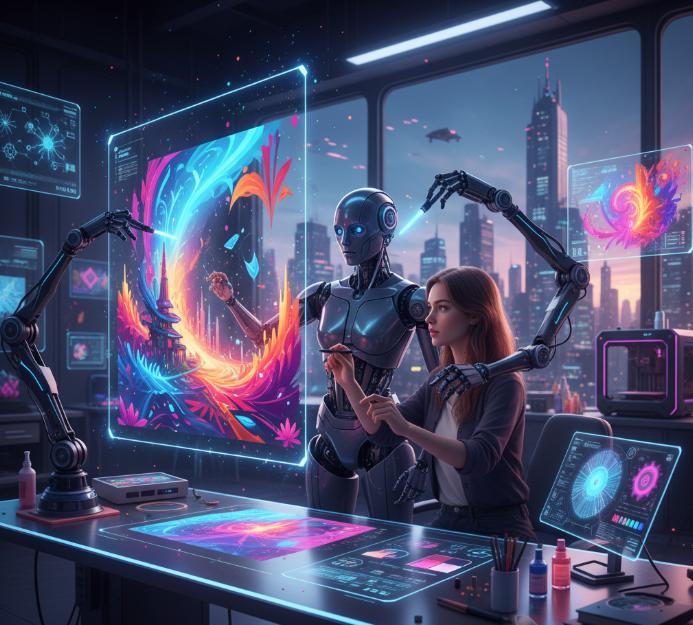
This ability has created a new creative partnership between humans and machines.
AI in Movies: The Future of Filmmaking
The film industry is one of the biggest areas where AI creativity is making an impact. Traditionally, creating a movie required large teams of writers, artists, directors, actors, editors, and visual effects specialists. AI is now changing many parts of this process.
AI tools can help filmmakers:
- Generate movie concepts
- Write early screenplay drafts
- Create visual effects
- Design fictional worlds
- Produce realistic animations
- Assist with editing and post-production
Independent filmmakers can now create cinematic scenes without expensive equipment or large production budgets.
Imagine a future where a single filmmaker can describe a complete movie idea:
“A space explorer discovers an ancient civilization on a distant planet.”
AI could generate characters, environments, dialogue suggestions, camera angles, and even background music.
However, this technology also raises concerns. Actors and filmmakers worry about AI-generated characters replacing human performances. Questions about ownership, copyright, and the value of human creativity remain unresolved.
AI and the Music Revolution
Music has always been deeply connected to human emotion. Songs reflect personal experiences, cultural movements, and individual expression. Yet AI is entering the music industry at an incredible speed.
AI can now:
- Compose original melodies
- Generate background scores
- Create different musical styles
- Assist singers and producers
- Produce experimental sounds
A musician can provide a simple idea, and AI can suggest harmonies, rhythms, and arrangements.
For example, an artist could request:
“Create a dramatic cinematic soundtrack with emotional piano and powerful orchestral elements.”
AI can generate a composition matching that description.
Some musicians see AI as a creative assistant that expands possibilities. Others argue that music without human emotions and life experiences lacks authenticity.
A machine can create a beautiful melody, but can it understand heartbreak, happiness, nostalgia, or love?
That question remains at the center of the AI creativity debate.
AI Storytelling: Can Machines Write Great Stories?
Storytelling is one of humanity’s oldest creative traditions. From ancient myths to modern novels and films, stories connect people through shared emotions.
AI writing systems can now create:
- Short stories
- Movie scripts
- Poetry
- Advertising copy
- Game narratives
- Fictional characters
AI can analyze storytelling structures, understand character development patterns, and generate narratives in different styles.
However, great storytelling is not only about structure. The most memorable stories often come from personal experiences, cultural understanding, and emotional struggles.
A human writer may create a powerful novel because they experienced loss, discovered love, faced challenges, or observed society.
AI does not experience life. It learns from information about life.
This difference creates an important distinction between generating content and truly creating art.
The Debate: Is AI Creative or Just Imitating Humans?
The biggest question in the AI creativity revolution is whether machines are genuinely creative.
Supporters argue that creativity is about producing something new and valuable. Since AI can generate unique images, music, and stories, they believe AI demonstrates a form of creativity.
They compare AI to traditional tools. A camera changed painting, synthesizers changed music, and digital software changed design. AI may simply be the next creative instrument.
Critics argue that AI lacks consciousness, emotions, and personal experiences. They believe true art requires intention and meaning.
A human artist does not simply combine patterns. They express ideas, emotions, memories, and perspectives.
A painting created by a human may represent years of personal struggle. An AI-generated painting may look beautiful but does not contain personal experience.
The debate is not only about technology—it is about how society defines creativity itself.
The Rise of AI-Human Collaboration
Instead of replacing artists, AI may become the most powerful creative tool ever created.
The future may belong to artists who know how to collaborate with artificial intelligence.
A designer can use AI to explore hundreds of concepts before choosing the best one.
A filmmaker can use AI to visualize ideas before production begins.
A writer can use AI to overcome creative blocks.
A musician can experiment with new sounds.
In this future, AI becomes a creative partner rather than a replacement.
The most successful creators may not be those who compete against AI, but those who understand how to combine human imagination with machine intelligence.
Challenges Facing AI Creativity
Despite its impressive abilities, AI-generated creativity faces several major challenges.
Copyright and Ownership
Who owns AI-generated artwork?
Is it owned by the person who gave the instructions, the company that created the AI model, or nobody?
Legal systems around the world are still trying to answer these questions.
Authenticity
People may begin questioning whether creative works are human-made or AI-generated. This could change how audiences value art.
Job Disruption
Many creative professionals worry that AI could reduce opportunities in industries such as:
- Graphic design
- Animation
- Advertising
- Voice acting
- Music production
- Writing
While AI may create new jobs, it may also transform existing careers.
Bias and Originality
AI learns from existing human content. If training data contains cultural or creative biases, AI-generated works may reproduce those limitations.
Will AI Become the Next Great Artist?
Artificial intelligence may create stunning artwork, unforgettable music, and impressive stories. It may even produce works that humans consider beautiful and meaningful.
But becoming a “great artist” requires more than technical ability.
Great artists influence culture. They express unique viewpoints. They challenge society. They communicate human experiences.
AI can generate creative outputs, but whether it can truly become an artist depends on how we define art.
Perhaps the future will not be about choosing between human creativity and artificial intelligence. Instead, the next generation of masterpieces may come from collaboration between human imagination and machine capability.
Conclusion: The Future of Creativity Belongs to Both Humans and AI
The AI creativity revolution is not simply a battle between humans and machines. It is a transformation of what creativity means in the digital age.
Artificial intelligence can already create images, music, films, and stories that were once impossible for machines. However, human emotions, experiences, and imagination remain the foundation of meaningful art.
The next great artist may not be a human or a machine alone. It may be a new kind of creator—one who combines human vision with artificial intelligence to produce ideas that neither could achieve independently.
The future of creativity is not about replacing artists. It is about expanding what artists can imagine.