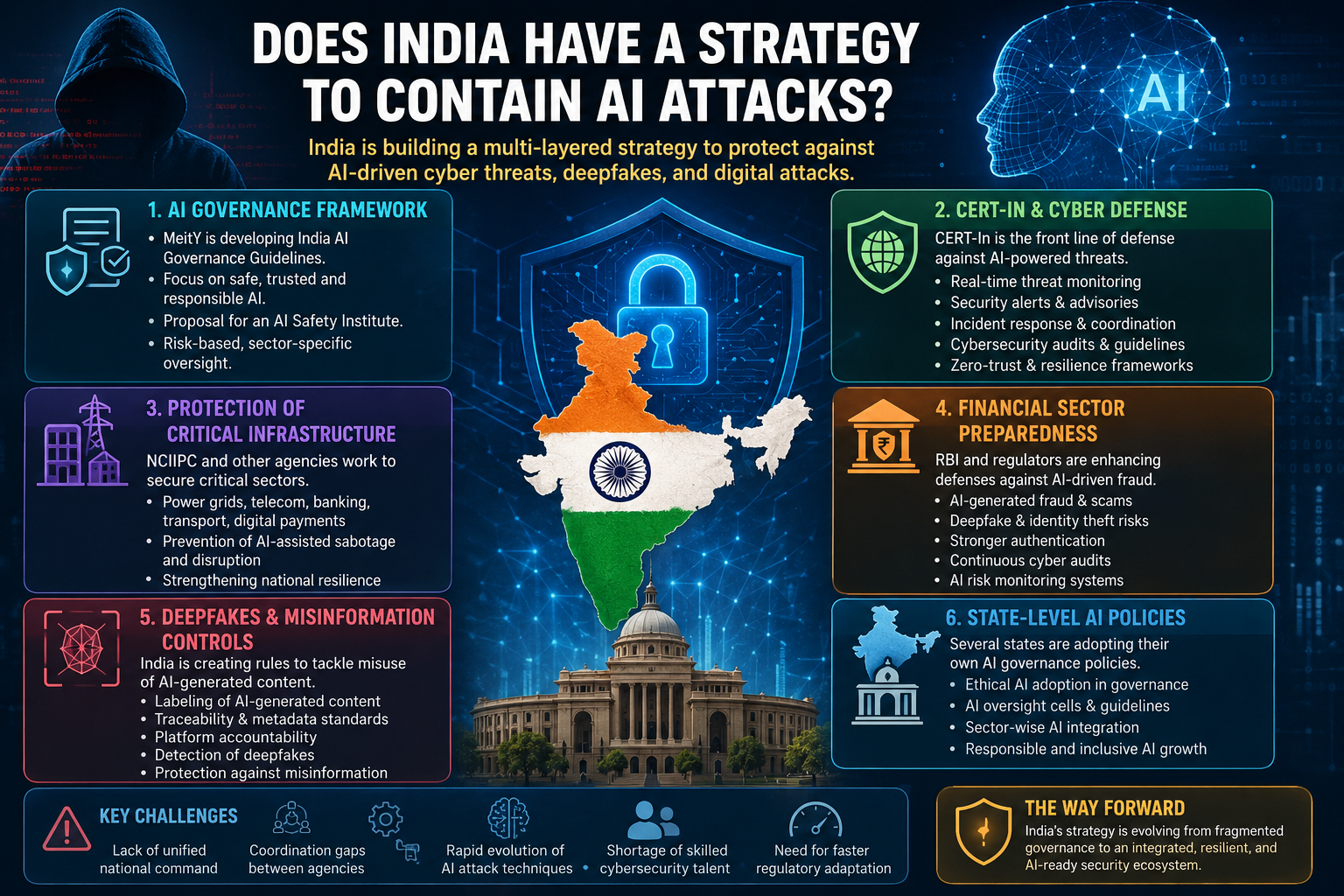
Does India have a strategy to contain AI attacks?
Artificial intelligence is increasingly being used not only for innovation but also for cybercrime, misinformation, and automated hacking. As AI-driven threats grow more advanced, India is actively developing a multi-layered strategy to defend its digital ecosystem. While there is no single “AI war doctrine,” the country is building a coordinated framework involving cybersecurity agencies, regulators, and emerging AI governance rules.
1. India’s AI Governance Approach
India’s AI strategy focuses on “safe and trusted AI innovation” rather than heavy regulation. The Ministry of Electronics and IT (MeitY) is developing guidelines that emphasize:
- Responsible AI development and deployment
- Risk-based oversight instead of blanket restrictions
- Sector-specific governance (finance, health, telecom, etc.)
- Creation of AI safety and evaluation mechanisms
A key proposal includes establishing an AI Safety Institute, which would study risks such as:
- autonomous cyberattacks
- AI-generated fraud
- deepfake misuse
- model manipulation and bias
This approach aims to balance innovation with security rather than slowing AI growth.
2. CERT-In and Cyber Defense Infrastructure
At the operational level, India relies heavily on the Indian Computer Emergency Response Team (CERT-In), which acts as the national cyber incident response agency.
Its role in AI-related threats includes:
- Monitoring cyber threats in real time
- Issuing security alerts to organizations
- Coordinating responses to cyberattacks
- Enforcing cybersecurity audit requirements
- Advising on zero-trust security frameworks
CERT-In has also warned about the rise of AI-powered cyberattacks, including automated phishing, malware generation, and system vulnerability exploitation.
3. Protection of Critical Infrastructure
India treats sectors like banking, power, telecommunications, and digital payments as critical infrastructure.
Agencies such as the National Critical Information Infrastructure Protection Centre (NCIIPC) work to:
- Secure power grids and financial systems
- Prevent AI-assisted sabotage or disruption
- Strengthen resilience against coordinated cyberattacks
This is especially important because India’s digital economy depends heavily on systems like UPI and online banking.
4. Financial Sector and AI Threat Preparedness
India’s financial regulators, including the Reserve Bank of India (RBI) and other bodies, are increasingly focused on AI-driven risks.
Key concerns include:
- AI-generated financial fraud
- Automated identity theft and impersonation
- Deepfake-based banking scams
- Algorithmic exploitation of financial systems
To counter these risks, regulators are pushing for:
- stronger authentication systems
- continuous cyber audits
- AI risk monitoring frameworks
- improved digital fraud detection systems
5. Deepfakes, Misinformation, and Social Risks
One of the most visible AI threats is the rise of deepfakes and synthetic media.
India is working on rules requiring:
- labeling of AI-generated content
- traceability of synthetic media
- platform accountability for misinformation
- detection tools for manipulated audio and video
These steps aim to reduce risks related to:
- election interference
- social manipulation
- identity fraud
- online harassment campaigns
6. State-Level AI Policies
Several Indian states are also building their own AI governance frameworks. For example, Odisha has introduced an AI policy focusing on:
- ethical AI deployment in government services
- dedicated AI governance units
- responsible AI adoption in public systems
- sector-wise AI integration
This decentralized approach allows faster experimentation at the state level while aligning with national guidelines.
7. Key Challenges in India’s AI Defense Strategy
Despite progress, India faces several challenges:
- Lack of a single unified national AI cybersecurity command
- Coordination gaps between multiple agencies
- Rapid evolution of AI attack techniques
- Limited skilled cybersecurity workforce at scale
- Need for faster regulatory adaptation
Experts argue that India’s system is still evolving from fragmented governance to integrated defense architecture.
Conclusion
India does have a clear and expanding strategy to contain AI-driven attacks, but it is not centralized under a single authority. Instead, it is a multi-layered system combining policy frameworks, cybersecurity agencies, financial regulators, and state initiatives.
The focus is on building resilience rather than restricting AI development—ensuring that innovation continues while critical systems remain protected from increasingly sophisticated AI-enabled threats.
As AI threats evolve, India’s next challenge will be tighter coordination and faster response mechanisms to match the speed of AI-powered cyberattacks.